
City Walkthrough & Tutorial
Starting Off
This is more of a step-by-step procedure than a hint section.
- If playing in campaign mode, consider doing the following steps, but this cannot be done if you’ve just started a new game.
- Load the file "lastyear".
- Once your city has loaded, wait for your soon-to-come promotion. If you made any last minute changes to your province before being promoted, and you think that the change might have affected the emperor’s decision to promote you this year, than make these changes now, and wait for your promotion.
- Once you are promoted, select your next province to govern.
- If you are not satisfied with the new river layout, than go back to step one.
- An appropriate site for a Defense type of city is a river running from the bottom of the map to the right, or symmetrical equivalent. A city built for Population would have a river of an irregular shape, covering the highest amount of space possible. A Mercenary city governor can have any type of river.
- I recommend pausing the game before proceeding. Begin construction by making water available to your city. I recommend building one reservoir and one fountain beside the reservoir. These essential structures should be built alongside the river of course. Beside the reservoir and fountain, build a hospital, rhetor and market in a single row, still building alongside the river. Behind the market, and beside the hospital, build a prefecture. Now, make a cane-shaped road that will reach all of these buildings. On the other side of the street, build a bath house that faces the middle of the row located on the other side of the road. Beside the bath house, build a grammaticus, theater, and two fountains on the corners of the (purple) pipe access/water square. See the Money Saving Tips at the end of this document for an explanation why you should build these (fountains).
- Build a block of housing behind the 2×2 building row (The grammaticus, theater and bath house row). Make it small enough for the walkers to access, but big enough to create good population growth. I recommend block sized four by ten squares, the longer part being alongside the 2×2 building row.
- For every 5000dn remaining, consider building a basilica. Temples carry half of that (2 500dn) and shrines carry even less (app. 1 000dn), so build those structures if you do not wish to get a robbery.
- Here’s more or less what the finished product should look like:
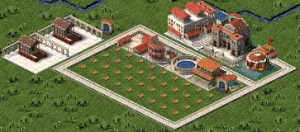
- Once February hits, the pleb requirements are going to go up fairly high, so prepare yourself by increasing pleb welfare to about 15dn per month. Expand progressively, but fairly slowly. Remember that the more housing you build without adding new land-value-increasing structures, the more your current housing will suffer. Add the occasional entertainment structure and keep up with demand for everything. Prepare yourself for riots and other problems. Once you get your treasury stabilized, proceed with developing your province.
- Some people have been complaining that even with the speed at ten, it will still take three or four minutes to go through one year. A simple way to beat this is to go under the speed menu and select accelerated time and sit back and relax. Each month will take about 15 seconds to go by, and the time will resume normal speed whenever a message appears ( i.e. an invading army, stolen Dn., end of year statement, etc.) -The Warlock
Land Values
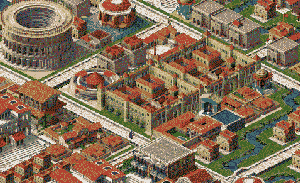 Here you see two large palaces. The land value here is 64, the required amount to construct this type of housing. Notice that the palaces are close to a grammaticus, hospitals, a library and a market. The palaces also have their own forum, baths, shrines and water supply. When managing land values (especially higher ones), keep these thoughts in mind:
- Check out the Building Directory to set development goals.
- The larger housing (Villas and Palaces) only need to have all their needs satisfied on one third of the squares that they occupy. For example, a palace only needs an entertainment rating of 9 on three out of nine that it occupies to maintain an entertainment rating of 9 for the whole structure. Sometimes, you may get away with having all the needs satisfied on only one square, but this does not always work.
- Prevent the Population Dip at all costs. The dip can cost you your expensive housing and can even eliminate some of your housing.
- As you can see from the picture, the palaces have automatic coverage at all times by land-value-increasing buildings. In order to develop higher land values, you shall need this strategy. Keep the baths, forums, schools, hospitals, libraries and worship buildings close, but keep markets and prefectures at least three squares away, but not too far away (More than five or six squares at most) Walkers have pretty short lives and their effects are eliminated quickly once they pass by housing, so don’t rely entirely on them!
- Remember to have all your housing accessible by road. Speaking of road access, remember that hospitals, libraries, and buildings that produce walkers need direct road access at all times to function effectively.
- Make sure to prevent disasters in the area, especially riots because they reduce land values drastically by creating rubble. Even riot presence in the vicinity could lower land values. See the Dealing with Problems section for advice on dealing with these disasters, and how to prevent them.
- Romans hate open spaces. Strongly avoid building housing blocks near empty land. This is one of the major causes of the Population Dip.
- Land values for housing and land values for non-housing (Multiple stature) buildings are different. These non-housing type buildings are affected by much fewer limiting factors than normal housing, and the limiting factors that do act upon them only affect their land value slightly. For example, you can easily bring a basilica up to a high stature (Let’s say with a land value rating of 53), although it has no external security and is in the proximity of a business, just by placing some plazas around it.
- Use the query tool often to check what residence wants if they are shrinking or not growing.
- Never leave rubble lying around and if you can afford it build roads out of plazas and build grammaticus because they are cheap and really please people.
Managing Your Industries
Your industries can be an important source of income for Mercenary city governors. They also make good use of provincial industry.
- You will probably begin to build industries later in your city development. If you have a lot of expensive housing, consider building the industries in areas already limited in growth, or in areas that have many non-housing type buildings.
- Make sure that a market is beside each of your industries. This will eliminate any problems caused by the short-term effects of walkers.
- The effects of high Industry Taxes are evident when all of your industries have production reductions at the same time. The diminished production caused by taxes is explained with the "insufficient city-wide demand" comment. Check out the Treasurer section in the Forum page for information on managing your taxes.
- Placing housing around your industries in the effort to provide decent workforce is a seemingly logical, yet risky idea. Housing placed both near an industry and on the edge of city limits will cause riots in the area for sure. Unrest, strangely enough, will not rise in such housing so rioting generally cannot be predicted. Avoidance is quite easy:
- Build industries in the inner-city area, but beware of the associated wide-spread limiting factors.
- Surround your workers’ housing with another type of building. Temples usually work effectively. This is my recommendation.
- A road that surrounds your industrial community will reduce the risk of a riot slightly.
- Consider building your workforce housing right beside a river.
- If you wonder why you cannot make raw materials available from your province, see the Trade and Industry section on the province level page for information.
Protecting Your City
Internal Security is good at any time. It will minimize the chance that riots will occur, and stop riots if by any chance they do occur. The presence of vigils will also raise land values. Vigils also take care of invaders if they reach your city, like soldiers. Please keep in mind that vigils are quite "shy" though, so they let invaders come to them instead of running after invaders like soldiers do.
External Security is only necessary if you are building in City-Only mode, or if you are a governor that builds for Defense. Installing external security is also a good way to spend excessive money if applicable.
- If you are building a wall to protect your city from invasion rather than to simply allow land values to go above 42, than do not build the wall on the edge of the map. If you do build a wall at the edge of the map, than invaders will not be hindered by its presence.
- Barracks are used to stop an attack once an invader is inside the city. Towers, on the other hand, will help stop an invasion before it reaches the city. Try to build more towers than barracks: It’s cheaper and more effective.
- One option is to wall off your entire map along the outside as an expensive but instant security system.
Dealing with Problems – Unrest and Riots
Rioting will probably be the most common problem that you’ll experience. The usual cause for rioting is unrest, but it’s also partially caused by the Population Dip (Described later in this document).
Unrest is caused by factors such as conscription and limiting factors, but is amplified by taxes. To make things easier to understand, think of this: You’re listening to music that has multiple instruments playing at the same time, each playing at a different volume level. These instruments are like different levels of unrest. If you turn up the volume, every one of the instruments will play louder. The volume is like tax. If you increase taxes, every housing unit that already has unrest will now have more unrest, and maybe some of the housing that did not have unrest before will now have unrest. Higher difficulty levels make unrest more likely.
If you’re unfamiliar with the preventative measures for high unrest and riots, here are a few:
- Avoid exposing your housing to the major limiting factors such as lack of baths, forum access or full water supply.
- Keep a low population tax, and balance it out with an increase in the industrial tax.
- Increase the number of luxuries (temples, plazas and entertainment). One idea is to replace your roads with plazas. Another idea is to use entertainment and worship buildings to fill in the squares where limiting factors reside, instead of putting housing in those areas.
- I have found that if an area of houses or a house, turn red (threat of riot), and you cannot figure out the immediate cause, just destroy the house (houses) and immediately place new houses in the same spot. This usually takes care of the problem for the time being, gives you more time to make adjustments and is cheaper than a riot. -Anonymous
Sometimes, no matter how many precautions you take, a riot will occur. If a riot does break out, it usually begins in large housing blocks, near the edges of your city limits or "filler" housing (Housing placed among many non-housing type buildings to fill in empty space.) Here are some strategies when dealing with riots:
- Build a tower in front of the rioter. This will hinder the rioter’s progress considerably. Sometimes the tower might even produce a soldier, who will eliminate the rioter immediately. Otherwise, the tower will slow the progress of the rioter long enough for vigiles to be able to intercept them.
- If there’s only one vigile in the area trying to intercept a riot, but he cannot because a building is in his way, than you may consider cutting him a path through some housing in order to facilitate access. If larger buildings must be destroyed in order for the vigile to access the rioter, or if you simply don’t feel like wrecking things, than try to rotate the map a couple of times and see if the vigile goes around his obstacles to intercept the rioter. In most cases though, the vigile will automatically circle the obstacles and take care of the rioter.
Population Dip
The population dip is an undocumented problem that can affect your city at earlier stages of development. The basic definition of population dip is "Invisible Unrest". A population dip does not create riots or any other type of physically apparent problems, but its effects can seriously harm your city.
The population dip reduces land values in your city considerably, often for no evident reason. Sometimes, you may be thrown into debt because of it ; Other times, you might lose some of your (previously thriving) housing blocks. Here’s some causes of the population dip, and associated solutions: Most of the causes listed below have a general solution: Progressive expansion. As long as you build or improve your city continually, you can usually avoid the population dip.
Cause: Open Spaces; Housing placed near city limits is likely to suffer from population dips.
Solution: Surround your city with a wall, road, or other type of inexpensive structure. Also try to keep your housing on the inside of your city, while other buildings stay on the outside. This method could use up more money though, since less housing is affected by a single beneficial structure.
Cause: Limiting Factors/Unrest; Lack of entertainment, bath house coverage, etc.
Solution: See the Riots/Unrest section above. The solutions are practically the same.
Cause: Lack of Funds; Prevents you from fixing problems, expanding, and generally making life easier for your people. This makes your residents move out!
Solution: Cheat if you have to. Another solution is to resist the urge to build too much. Set a minimum amount of money to have at all times. My recommended amount is 5000dn or more.
Cause: Unruly Population; Some provinces simply have a bad population from the start.
Solution: Avoid these provinces if possible; let ‘ol Pompous have them. The province description will tell you if the province’s populace behaves bad. If you decide to take these provinces on, than be very careful. There’s no easy solution for this one.
Cause: Wandering Walkers; If people don’t see walkers in their neighborhood often, they will move out.
Solution: Split up your city into smaller communities by removing road pieces in some places. Read the third tip in Money Saving Tips for details. You may also try setting up a single possible path for walkers by making a single long road for them to follow.
Money Saving Tips
When it comes to providing water for your citizens, than keep in mind that only bath houses and fountains must be placed inside the underground piping range. Housing only needs water from a fountain to receive a normal water supply: it does not need pipe access. Please remember that water that comes directly from a river or well will only create a primitive water supply; only fountains do the job right. An anon person adds: If you place a fountain next to a reservoir and the fountain won’t fill with water, try placing the fountain directly on top of the little green plants (bushes), in the grassy area of your city. This should fix your problem.
Also concerning water: you can save yourself some time, money and space by allowing multiple aqueducts to feed off a single reservoir. This is great if you don’t want a maze of aqueducts running through your city, as you may end up doing when it will come to providing water for areas that are distant from the river. Even if three reservoirs draw water from a single initial reservoir that is beside a river, all three will get a full water supply.
A nice thing I found out in CII: When I first began playing, I thought all of the sections of one’s city had to be physically interconnected by roads – after all, that’s the case in real cities. This means that your "walkers are liable to wander aimlessly, thus decreasing their range of effectively. In the game, though, you can create numerous enclaves with their own short road system and facilities … and the shorter your roads, the easier it is to get good market, forum, prefecture coverage, etc. Pretty handy.
For instance, Are you tired of that annoying Robbery message because you forgot how many temples you had? Then, you have to scan your city to find space near a forum to plunk down another temple. Well, now, I create a separate area for just temples, hospitals and libraries. It can be anywhere… All it needs is road connection to a forum! –Glen Homan
Glossary
Defense City: A city built for defense is a city where one’s primary goal is to keep invaders out. This kind of city is appropriate if:
- You are building in city-only mode, and are experiencing many attacks, or want to prepare for attacks if they do occur.
- You find no need for a cohort. Most of the attacks that you do experience are minor and do not affect other structures/cities in your province, therefore you can easily repel an invasion (in the city view).
- Your city is placed so that your troops will not be able to intercept the enemy in time if an attack does occur. Usually this is necessary if your city is very near a "To: Someplace" sign.
- You want to ensure the maximum level of security possible, just in case. Usually you want to do this if the province description mentions that there are many raids in the area, and your troops are not ready to fight yet.
A defense city should have a river that runs across the corner of the city map. This is to minimize the chance that invaders will enter your city limits at a place where structures are built. If structures were placed alongside a river that ran straight across the map, invaders would have a better chance of reaching a populated area, no matter from what side they attack. A city placed in the corner of the map would allow your soldiers and vigiles to respond to an attack without having to run through a maze of roads in order to intercept, and the attackers rarely actually get to the populated area because of the additional distance to travel (If they begin at a corner or side opposite to the city).
A defense city should have at least one barracks unit, and as many prefectures as possible. The areas that are close to the edge of the map should have a wall protecting them.
Population City: A city built for population is one that has logically positioned buildings and roads for maximized land value, as well as a happy population and decent economy. The general point of building a city like this is to feel dedicated to your people rather than to anything else. This kind of city is appropriate if:
- You are planning to manage a long term city-only game.
- You want to work mainly on improving your culture and prosperity ratings.
- You want to see the palaces "In real life."
- You are trying to get the highest population you can
This type of city should have a long and swerving river that takes up the highest amount of space possible. This is to make it easier to provide water to the outer limits of your city (later in the game).
Population cities have plenty of land value raising buildings, relatively low taxes and much housing. An industry here and there will also contribute to the growth of this type of city.
Mercenary’s City: A city built by a mercenary city governor is one that has relatively high taxes and many industries. The general point to built a city like this is to make as much money as possible. This kind of city is appropriate if:
- You want to jump from province to province quickly, having a good personal savings account to back you up along the way. A large surplus of money could allow you to build (freely and quickly) what is necessary in order to advance to the next province.
- You want to experiment with the prosperity rating, or want to see how far up you can push taxes; how many industries you can build before your people go crazy.
- You find that it’s easier to get your more money from industry and taxes, not luxury homes.
Any type of river is appropriate for a city like this. Preferably, though, a river similar to that used in "Population" cities is good for future city expansion possibilities.
The primary source of income for a Mercenary’s city is industry. In order to have a properly functioning "Municipal Industry Base", your province must be well developed first. Most of the housing in this type of city can be classified as "worker’s housing", housing that has low stature and is used basically to support the production of industries. Tax revenue, as mentioned above, is also an important source of income ; primarily industry taxes, of course. Do not increase your population tax too much, for a Mercenary’s city is probably a city with plenty of unrest.
46 Comments »
RSS feed for comments on this post.
Is there any way to import a city (city only mode) to a province?
Comment by Louise — March 3, 2008 @ 3:48 pm
How to import a Caesar II city made in city mode to a province save game? That is a good question. I have wondered about that too, but I don’t know if it can be done.
Comment by Administrator — March 3, 2008 @ 4:32 pm
how do i get external security???
Comment by patrick — April 28, 2008 @ 8:16 am
Found this game recently and started to play it again. Decided to build a city for population. Just curious as to how high anyone has gotten their population to go so far.
Comment by Kevin — August 24, 2008 @ 12:49 pm
The largest population I achieved was a little over 30,000.
Comment by tk — August 27, 2008 @ 7:39 pm
You can get 60000 population in palaces in your city.
It’is really to build 3-5 palaces without savings on normal difficulty level.
And you can do it early than peace rating grow to aim.
Taxes may be high 10-15% (if your houses ate luxury) and 25% if only palaces.
You will have problem to spend money 🙂
Comment by WIldKOT — September 10, 2008 @ 10:33 am
My TOP record, is 100,000 people. It took me a long time to get everything balanced, but it looks great now that I’ve completed it.
http://www.caesar2.com/wp-content/uploads/2014/02/aesar2-one-hundred-thousand-city-population.jpg
to Patrick: you get external security by surrounding your city with a wall. Took me forever to figure that out when I first started.
Comment by SimpsonsFanatic — September 14, 2008 @ 1:12 pm
I just reinstalled the game, does anyone happen to have a saved game where you are Caesar already? I want to start a new city without him hassling me… preferably in Province mode. My email is SimpsonsFanatic04@hotmail.com if anyone would be able to send me the saved game. Thanks!
Comment by SimpsonsFanatic — September 14, 2008 @ 1:17 pm
Never mind, reinstalled it and found old saved files. Just beat my record by 7,000 with a new design!
http://www.caesar2.com/wp-content/uploads/2014/02/caesar2-one-hundred-seven-thousand-city-population.jpg
Comment by SimpsonsFanatic — September 17, 2008 @ 9:34 pm
Guide to making the “Perfect” Population city in Caesar 2.
Let me start by saying that this type of city is one in which you cram as many palaces as possible into this 80×80 map— literally every square inch of real estate is used and is useful (so don’t fill in blank spaces with shrines).
Fundamentals:
A few things to know before you build your perfect city.
Type of river: The river should take up as little space as possible, and an ideal river would be an exact right angle… but since it never spawns like that, a river that goes up and to the right will do. DO NOT use a river that goes from one end to the other.
Building range:
I’ll give the number of squares that extends from each building, what I call the base range. I’ll only give the ones that are useful, ie. Regular buildings like Arenas or Theatres are USELESS because the upgraded versions take the same space with more influence. Same with a Circus Maximus because it takes up a lot of space, and space is essential.
Market: 3
Aventine: 3 (Do not use the Palantine forum because it takes up too much space)
Janiculan: 4 (important for later)
Baths: 6, 7, 8, 9 (as it increases in stature, massive range, use this to your advantage)
Circus: Depends how you position it, vertically or horizontally
Coliseum and Odeum: Build the entertainment close together so their base ranges overlap.
Rhetor: 8
Shrines: 3 (Temples and Basilicas are useless. Why? You guessed it, real estate. Plus, a row of shrines improves land value better than a row of Basilicas.
Fountain: 6
Praefecture: 3
Plazas: Affect land value of buildings directly adjacent (one square away).
Walkers:
VERY IMPORTANT: ALWAYS only have ONE path for a walker to move. Even having one fork in your road system can have devastating effects if you’re trying to maximize your population, especially with the kind of setup I am about to explain.
Building style:
I notice a lot of builders tend to build houses then surround it with roads. But when you build roads on the perimeter you end up surrounding those houses with support structures like markets and entertainment, which is a very inefficient use of space because a building’s range extends in all directions, and its influence is only being put to use on one side. This is why I build my houses in a large complex and have all support structures on the INSIDE.
Calculate your space:
A map has 80×80 spaces. Surrounding a city with a wall gives you 78×78 spaces. My complexes are built so that two can fit into the width of the map. They are 36×16 spaces each. If you want to maximize, make sure you calculate how much space your buildings will take beforehand. Planning will really help in the long-run.
Tricks that will help maximize your space usage:
Remember base range is very important. As I mentioned above, a Janiculan’s range is 4, which is very useful when you are low on space.
Allow me to explain this significance… because a Janiculan’s range is 4, it can cover TWO hospitals placed next to each other. 3 spaces cover one hospital, and that last space covers the second one. You don’t need walkers to do anything. At this point the base range covers those hospitals already. You don’t need the forum right next to a building and you don’t need to physically connect a road next to a forum. As long as a road is next to a hospital, and both are within range of a forum, it will be functional. Notice the screenshots I posted where my walls have roads built into them: the roads do not touch the forums physically, but both the hospital and road is within the range of the forum. You can do this with walls and aqueducts if you don’t have the real estate to build road systems. With regard to hospitals and libraries, I suggest using as few roads as possible.
RANGE IS IMPORTANT, ALWAYS KEEP IT IN MIND. I exploit this to the max in my complexes as some palaces only have 1 of 9 squares with all requirements. This is enough as long as you are able to maintain the value in that one square (which is why base range and walkers walking only in one path is so important).
Result: If you build a complex such as the ones above, 36×16, the exterior palaces support a population of 20,000. I added the palaces on the inside while tweaking my setup. Building just one complex will support you financially the rest of the way… in fact, once you’re done you won’t be able to charge 25% tax because the amount of denarii you rake in causes a glitch and you lose money overall. I have my tax set at 16%, any higher causes the glitch, but I still get about 250,000 denarii a year. And make sure you’re Caesar, or the emperor will tax the hell out of you.
Hope you enjoyed this little tidbit of info, just wanted to add to this wonderful walkthrough.
By the way, here’s my new map at 113,000 population. This is the most I can get by conserving every piece of space possible and using the tricks I mentioned above. Best of luck to all!
http://www.caesar2.com/wp-content/uploads/2014/02/caesar2-one-hundred-thirteen-thousand-city-population.jpg
Comment by SimpsonsFanatic — September 20, 2008 @ 11:06 pm
SimpsonsFanatic: Wow, that is a very impressive city! Thank you for sharing your techniques. If you would email me your save-game I would like to add it to the city download area.
Comment by Administrator — September 21, 2008 @ 12:34 am
Typo from the above post, meant to say 15,000 per complex.
As a side note to keep in mind, having complete hospital coverage is necessary, but complete library coverage is not. You only require 80% coverage to get 62 land value, and that will freeze your large palaces in place.
With 80% coverage, you will usually stop at the Small Palace level… BUT, you can do this with your existing Large Palaces: destroy the reservoir water supply to the Large Palaces in another complex, wait one month for them to change back to small palaces, and you’ve effectively dropped your population by nearly half. This means you’ll have complete library coverage, and 64 value, for one turn. Replace the reservoir you destroyed, and all the Small Palaces get upgraded.
Glad you liked the city Admin, I’ll upload all the different templates I used leading up to this design so you can see the progress I made along the way. Lots of planning was involved, and 113,000.sav is only the finished product.
Template.sav is the kind of river you want to get.
Copy of lastyear.sav is the initial design I went with. In fact, the U-shaped design is something you can use to get your initial funds.
The tester.save maps are the new designs for my initial complex.
67000+.sav is when I first tried to implement that design.
100,000stable.sav is what I first thought was the maximum population until I discovered that base range trick
106500.sav and on uses a different river from 100,000. From here to 113,000.sav I keep changing the internal design to fit in more buildings and alter the hospital placements at the bottom.
http://www.caesar2.com/wp-content/uploads/2014/02/caesar-ii-113000-huge-city-population-savegame-maps-sav.zip
Hope this gives everyone more building ideas!
Comment by SimpsonsFanatic — September 21, 2008 @ 11:12 am
Here’s a more concise update for the building ranges:
Coliseum: 7×7
Circus: 6×6
Odeum: 7×7
Circus Maximus (avoid using): 8×8
Theater (avoid using): 5×5
Arena (avoid using): 5×5
Rhetor: 8×8
Grammaticus: 6×6
Baths: 5×5, 6×6, 7×7, 8×8
Market: 3×3
Praefecture: 3×3
Barracks (avoid using): 3×3
Aventine: 3×3
Janiculan: 4×4
Palentine (avoid using): 5×5
I managed to fit in another 2,000 into my city. This, I think, is my absolute limit, I can’t fit anymore hospitals inside my complexes even if I tried. Here’s the map:
http://www.caesar2.com/wp-content/uploads/2014/02/caesar2-one-hundred-fifteen-thousand-city-population.jpg (Composite Screenshot)
http://www.caesar2.com/wp-content/uploads/2014/02/caesar-ii-115000-huge-city-population-savegame-maps-sav.zip (.sav file)
This’ll be my last post here, unless there are questions. I’ve had my fill of Caesar!
Comment by SimpsonsFanatic — October 5, 2008 @ 10:03 pm
Crazy. You have managed to cram an impressive amount of population onto this map.
Comment by Administrator — October 6, 2008 @ 8:24 am
Please tell me how to get shots of maps in CaesarII, whether in saves or the game itself.
I don’t use DOSBOX, I simply run the game from windows xp
Comment by Cactus — October 26, 2008 @ 4:52 pm
Hi Cactus, those shots of maps are composites. I took a screenshot of a part of the map with the “prntscrn” key, and then pasted the pieces together in Windows Paint.
As a side note, I discovered that you don’t have to have a forum overlap with a hospital per say, but you only need a road that is covered by forum, and is adjacent to that hospital. So the road can be in the read, but the 9 hospital squares can be black. Managed to get up to 117,000 by doing that.
Comment by SimpsonsFanatic — October 28, 2008 @ 9:31 pm
Wow
117k of people
I fell off my chair
Incredible
I always had to use money cheats to survive in this game and waited no longer than first note of promotion to get the hell out of the province I used to govern
You guys are real lunatics when it comes to C2
GZ!!!
Comment by Wizard2579 — February 15, 2009 @ 6:01 am
Thanks to all who posted strat & guides. I remember playing this game allot when I was like 10 or 11 but could never beat it but now I’m owning all over the place 😀 (well relatively ofc)
Also I think anyone who can fit more than 100k people on one map should establish a town IRL :p
Comment by Ballza — June 25, 2009 @ 4:49 pm
Is it possible to run Caesar 2 in Windows Vista or is XP the limit?
Comment by Dan — August 17, 2009 @ 10:45 am
To Dan = you can run ceasar 2, or any other dos game, in vista with DosBox. simple to use and doesn’t take up much space on harddrive. one note though, mine doesn’t like to run multiple windows. if i am playing and open a new window with something else, like mail, it errors, could just be my computer though. Good Luck 🙂
Comment by IRNotAmused — March 12, 2010 @ 6:41 am
Hey I downloaded the game and DOSBox and everything is working very well. The only problem is that I’ve noticed there is absolutely no sound, even though all sound and music options are at their maximum. Is there a way to fix this, because I do miss the music. 🙂
Comment by Aranel31 — March 14, 2010 @ 11:57 pm
Hi,
I got a request for Wheat from the emperor. Before I could send him the gift (in the dialog window), a new one appeared and afterwards the other one was gone… Now, in the Forum screen, clicking on “Rome” I see that the emperor requests wheat, but I can only send him a gift in denarii… How can I please him and send ressources?
Comment by Säb — May 4, 2010 @ 12:47 am
Hi there,
I’m running it on my Win7 X64 laptop with VirtualBox on DOS6.22. Actually, it’s great playing the game I tried (and failed at) at 10/11 years. 🙂
cheers
Comment by Jay — July 5, 2010 @ 2:28 am
Hi,
Got a request for cattle on the Illyricum map, but with three ports I had only two goods – graes and silk. Any idea how to get the cattle? Something seems to be weird/wrong.
Comment by lkc159 — September 26, 2010 @ 10:03 pm
@lkc159
You either have to have a farm to make cattle, or cattle may come from another sea route that your port is too far away from.
Comment by SimpsonsFanatic — October 6, 2010 @ 11:10 pm
Does anybody have a Caesar 1 walkthrough? It was released the year after I was born , but I’d like to play the Caesar series from the beginning 🙂
Comment by Riniel — September 4, 2011 @ 11:22 am
Does anyone now if the source code of the game is avaiable to download anywhere? I would love to check it out and if possible “update” the game, that would be, to make maps bigger (at least city ones) and add things like more walkers, functional province walls and better things like sea battles, the posibility of running several provinces at once (once you attained the right ranks of course) and letting a “governor AI” to run your cities making them grow slowly (of course if all that is possible).
In the end I would love to see a remake of the game updated to current pc standars. From Caesar III and on the franchise got the wrong way… the city/province mechanics and dinamics employed on this game are perfect and glorious. It’s the perfect recepie of both real time strategy and real time tactics! I allways wondered how this has not been employed in newer games, specially the new so called “strategy” games that have a ever increasing narrow point of view of what strategy means (they thend to confuse strategy with tactics).
@Säb, I know is like more than 2 year’s late, but I think the anounce will appear again several times (with ever increasingly angry tones) until you either send the darn wheat or the emperor gets tired of waiting and your favor falls.
Comment by Jorge — January 5, 2012 @ 1:11 pm
btw sorry for my very bad english.
Comment by Jorge — January 5, 2012 @ 1:14 pm
anyone have a link for the victory movie? i bet the game but all it does is says continue as caesar? if you click yes you get a new province. if no it takes you back to the main screen. i might just have to play until i have no more provinces left
Comment by ryan — January 22, 2012 @ 8:47 am
How is it that my houses disappear, everytime they are supposed to upgrade? Can someone please help me with this?
Comment by Anne — February 15, 2012 @ 11:24 am
How do I run the thing on 64 bit Windows 7? I’ve forgotten all my DOS…
Comment by Tom — March 9, 2012 @ 9:39 am
Hi everyone,
Does anyone have ananswer for Jorge ? I am interested too. I also would like to know if there is a way to play the “exterior” provinces in the game (Exterior Germany, Exterior Noricum, Exterior Pannonia, Exterior Dacia, Esterior Asia, Hibernia, Caledonia, etc….) ?
Is there also a way to change the source code for the design of the proovinces (to add farm areas or rocky areas) ?
Thanks for any help.
Comment by fsetton — July 26, 2012 @ 12:16 am
http://caesar3.heavengames.com/downloads/showfile.php?fileid=778
Long time ago I made a collection of all possible provinces in .sav format.
I uploaded it at the above address and I just verified the downloadbutton still works.
You have to unzip the files into your caesar2 directory to be able to play them.
Enjoy!
(admin edit: I verified that this zip file looks legit and made a local copy of the Caesar II save-games zip file. Nice work Martin and thank you for mentioning it here.)
Comment by Martin — September 15, 2012 @ 3:51 am
@fsetton
because of various limitations (the game was written 15 years ago) redesigning the game from source is a waste of time + who knows who has the source code. There was a source code petition for Civilization 2, but we found out it was lost long time ago. It’s just better to rewrite the game from scratch (like the freeciv or CivEvo projects for Civlization).
IIRC the “exterior” provices can be played but they are damn hard (even when you cheat 🙂 ).
Comment by diolk — September 22, 2012 @ 2:43 am
Hmm those exterior provinces are in my downloadable file.
Play them!
Comment by Martin — September 26, 2012 @ 8:39 am
I think you can download a patch somewhere that enables you to select the outer provinces. You’ll have to search it up on Google as I forget the site’s name.
Your houses disappear because the land value is too low. After a certain point, all empty land becomes devalued and simply placing a hut will not work. You will need things that raise land value, such as plazas or shrines adjacent to the house. By the way, 9 shrines raise more land value than one basilica.
(admin edit: The save-game that allows you to play those mythical exterior provinces was provided by Martin and is available here.)
Comment by SimpsonsFana — November 14, 2012 @ 1:06 pm
Hello,
First off, sorry, computer novice… I’ve been playing the game with Vista without many issues. However, in campaign mode I am experiencing two: 1. When I am promoted and then select my next province to rule, nothing happens. The province turns gray and I remain on that screen and can continue to choose more provinces to govern but it never launches. Does anyone else experience this issue? Is there a fix? 2. Maybe this isn’t an issue but just normal game play. When raiders arrive and I move my centurions, my treasury funds become exhausted quite quickly and I do not know why. Any help would be appreciated as I still love playing this game. Thank you
Comment by Stu Jackson — March 25, 2013 @ 12:22 pm
Hi all (hope someone is still reading and can reply!) – I have a win95 CD but I haven’t been able to play C2 from it ever since I moved on to WinXP. Any ideas folks? I really miss this game – it was so fun and challenging.
Martin – hi Pontius Pilatus! DX from C3H here! =)
Comment by DX — September 3, 2014 @ 4:59 pm
Hi DX friend from the past,
I think Caesar2 is playable under Windows XP and later OS but you best try the DOS version that is also on your CD.
You have to use the Install instead of the Setup if I remember correctly. There are often sound or mouse issues, but these can be remedied if you go for the Dosbox solution. Go to the main page here and you will find info about Dosbox and how to set it up.
Good luck.
Comment by Martin — October 3, 2014 @ 12:32 pm
Regarding the population dip: It is directly connected to the employment rate. At first people stream into your city because land values are high. But if you can’t employ enough of them they will simply leave and land values drop dramatically. The bad thing is that no message in the game will tell you the real reason, it ist just stated that land value is too low. So building shrines into your housing complexes won’t solve the problem, except for some employed people. If you offer enough jobs land value will rise again. Don’t forget that maximum 50% can work in industries.
The best building cost to employment rate have baths with 0.6 employed people per invested denarius. However they require many plebs. Rhetor is also a good employment structure with 80 people getting jobs. Most people are employed in forums (also see the FAQ page).
Comment by Agent75 — November 12, 2015 @ 4:54 pm
caesar 2 is playable in xp. verified by myself. however, dosbox can play it too. you just can’t manual the fights – gets an error
Comment by dd — February 14, 2017 @ 4:06 am
I realize this forum is 4 years old, but I wanted to let everyone know that a supported version of Caesar II is now available at gog.com. It leverages DOSBOX of course, but it’s preconfigured to run on a modern OS without issues.
Comment by JBreeze — March 3, 2017 @ 9:30 pm
POPULATION DIP AND GROWTH CONTROL
After much experimentation I have found a way around the problem. I’m using what I call the double-double configuration. It uses only the Aventine, Theater, Arena, and Circus. The upgrades aren’t needed as the area coverage works without them.
https://i1296.photobucket.com/albums/ag10/DonW427/Caesar2/EarlyCityConstruction_zpsumq5ec5w.jpg
Initial construction ignores Grammaticus, Rhetor, and Library. (This is an addition to an existing city; the initial construction would include one hospital.) Growth stops at Improved Insula without Grammaticus, which has a density of 36 people per square. If allowed to grow past this point it will reach Imperial Insula with a density of 54, and then grow to Simple Domus with density 20. That is the dreaded population dip.
Without double security you can’t grow past Simple Domus. That means you must enclose your city with walls and unbridged rivers. The wall is a major expense and you will want to build several neighborhoods up to Improved Insula with maximized businesses to be worth the expense of the wall.
Unfortunately, the next development barrier is only two steps up. You’re stuck at Average Domus (density 30) until they’re covered by a Rhetor and have Library access. So you wait to build Grammaticus, Rhetor and Library until after building the wall.
https://i1296.photobucket.com/albums/ag10/DonW427/Caesar2/TransitionToDomus_zpssz1acjny.jpg
Place only one Rhetor, one Grammaticus, and one Library. That keeps the rest of the city stable while one area improves up through Imperial Insula, down to Simple Domus, and then up to Large Domus (40) or Grand Domus (45). It can usually grow this much in a single year, but if your city is caught at any stage other than Imperial Insula or Simple Domus you’re probably OK.
Each Hospital and Library serve up to 1000 citizens. You can use either one to limit growth and prevent dropping off Grand Domus (45) to Simple Villa (25). Since these affect the entire city it can’t be managed one neighborhood at a time. I haven’t allowed my cities to cross into Villas, as I don’t want to work that hard.
Comment by Meticulon — March 25, 2020 @ 11:59 pm
I have found a little “trick” when placing industries such as a farm or quarry and you dont need to pay for it. To do this, if you are looking to place a farm, select wheat or grapes, hold that selection down and slide that down to where it can take the farm but dont let go of the mouse. Hover over that until you see the “farm” then hover the mouse on any plot of land and it will place the farm without cost. Build a road to that farm or quarry. You can also get “free” warehouse and workcamp by doing the same method. Ive been doing this since 1998. Somehow, this only works on the original cd. If you buy it from GOG, its a hit or miss. But whenever I play this game here and there, I always use that trick to save me some money.
Comment by CookiePup — March 26, 2020 @ 3:59 am
Any tips on winning Impossible level? I can’t figure out how to win the first province with only 5000 dn.
Comment by Cavin — April 3, 2022 @ 4:11 am
@Cavin, update, I was able to get to the first promotion on impossible difficulty. It is NOT easy. I think the key is starting with Corsica and Sardinia. I don’t know if it is a glitch but when “Large barbarian horde” attacks they hit the north island and disappear into the mountains every time (lost i guess). So here you don’t have the issue of your cohorts getting worn out by constant attacks. You do have to start cheap with a small city. I spent a little over 5k DN to start, went slightly into the red (maybe -600 to -700), and it took me years to turn a profit. You have also have to keep industries up and running in your province to meet the emperor’s demands. The key is to have enough plebs on provincial duty (at least 15) to keep things producing without breaking the bank. You can have one work camp per industry (farm or quarry) then destroy the work camp to move to the other industry if that is what is requested. This way all assigned plebs will move to the other industry and wont be split between two work camps. Leave your warehouses in place to save goods for future requests because they will continue and are relentless. This worked well for me, scale up your city once you start turning a profit and things will snowball. Best of luck.
Comment by Richard H — May 4, 2022 @ 11:40 pm