
The Caesar II Forum
Oracle
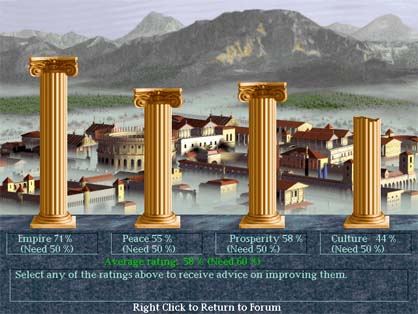 The Prosperity rating is very hard to increase if you have high operating costs at the beginning of province development. You have to have a surplus in order to get promoted.
- The Empire rating is probably the easiest one to increase. All you need to do is connect your city with other towns and build a trading post or two, and your rating rises to 40%. I use the Empire rating to get my average rating up to the required mandate.
- It’s easy to move the culture rating to "As high as it can be for your city’s current size" by building a whole bunch of basilicas along the edge of your city, and maximizing entertainment in at least a third of the city.
- The more you fight (And Win), the higher your Peace rating will rise. Building walls (Both on the City and Province levels), as well as cohorts will also get this rating to go up. The Peace rating will also rise naturally over time. The prosperity rating also grows naturally over time.
- When building in campaign mode, first develop your city then when you have enough money develop your province for fastest promotion. Sometimes you don’t even need to develop your province -Pendragon
Plebs
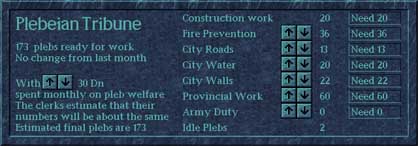
- Adjust Pleb welfare in 5dn increments. This will allow you to get the plebs you need more quickly, and will provide some extras in case of emergency.
- How to get free slingers: You can simply take plebs from the province level, where they work in industry and train them for a month as slingers. After the battle, back to work! So this actually cost you nothing, provided at that time you have about three industries running you train (e.g. 60 as slingers and let 30 to run the ind. at 33% capacity, it won’t kill you) –Sorin Cristescu
- Provincial Work pleb quantities do not always have to meet requirements, especially at easier levels. Often, you may get away with providing 25 plebs per industry while maintaining maximum production.
- If you pause the game while building, the pleb requirements might go up significantly once you unpause, so prepare yourself by having idle plebs ready at all times.
Centurion
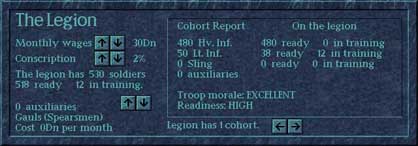
- If you lose some of your auxiliaries in battle, they will not be replaced automatically when they return back. Move the spending done on them up by one and then down by one, and the problem will be solved.
- The Centurion will increase your total operating costs dramatically. It’s important not to start off with spending more than 20dn a month. The soldiers take time to train anyway, so high salaries will do nothing but reduce your prosperity ratings. It is of course safer to give them high salaries when your budget has more surplus.
- If you haven’t figured it out already, the "Major, Minor, etc." settings designate soldier distribution in your cohorts.
- "Major" Cohorts have many soldiers, and their readiness is excellent.
- "Minor" Cohorts have little soldiers, and their readiness is reasonable.
- "Normal" Cohorts have a number of soldiers that’s between the "Major" and "Minor" Cohort types, and their readiness is high.
- "Demobilized" Cohorts have no soldiers at all, and the flag representing the cohort is immobile. The soldiers’ readiness is unfit.
It’s important to set the soldier distribution settings before your soldiers are trained. You cannot "transfer" soldiers between cohorts by changing the distribution setting.
- Auxiliaries are less likely to be available on islands or in provinces with much water.
Treasurer
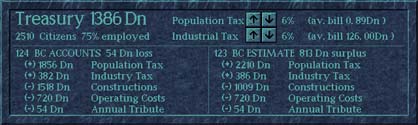
- If you cheat, set the taxes to zero. If you want to make plenty of money, set the population tax at 5 or 6%, and the industrial tax at 8%. For a happy populace, set the population tax at 3 and the industrial tax at 6%.
- If you monitor the budget table regularly, consider removing the Construction Costs from your calculation. This will give you a general idea of how much you could be making, and you’ll be able to figure out how much to spend on construction in a year without losing money.
- Industries don’t riot. Set the industry taxes at a higher level than the population taxes. You’ll know if you set it too high when all production across the city goes down at once.
- Taxes usually only cause unrest among poorer communities, especially those near industries. If you develop a city full that’s of rich people, increase taxes. If you have many industries and/or poor communities, lower them.
- You could raise pop. taxes gradually month by month until the population growth changed from Extremely Good to Quite Good, then crank it down a point. A note of warning: You have to re-check the pop. growth (Good, Poor, Quite Good, etc.) periodically after raising taxes. The people will tolerate tax increase for a while, but then they change their minds. I have finally come to the conclusion to just leave it at 5%, period!
29 Comments »
RSS feed for comments on this post.
hey, so first of all i wanted to thank the uploader of caesar 2 and the wonderfully informative admin on this forum, got it up and running, some kind of dos/windows version hybrid, but it works.
So now i`m thinking back to grade school when i used to play caesar 2, and i seem to remember some mellow background music wthat i was expanding and conquering empires to. IS this a figment of my imagination? or is there some missing file i can aquire? thankz
sincerey, a hardcore dos gamer
Comment by bigleftplaya — August 20, 2008 @ 2:09 pm
You’re not imagining, my friend. The Windows version has music, but the DOS version does not.
Comment by SimpsonsFanatic — September 21, 2008 @ 11:24 am
The DOS version DOES have music. I play the DOS version through DOSbox and I do indeed have music. I suggest going to the DOS prompt and running SETSOUND to configure your sound settings. General Midi or MPU-401 provide the best midi playback. Good luck.
Comment by Diogenes — November 11, 2008 @ 1:37 pm
Actually, there are two versions. The CD version has music for DOS – the floppy version doesn’t.
Comment by Diogenes — November 11, 2008 @ 1:42 pm
i just want to tell you
that Caesar II no longer available for download at abandonia
does anybody know any alternative download?
Comment by Shiro — November 26, 2008 @ 5:04 am
Both the Win and the DOS versions of Caesar2 have music.
But they are different, but the win version has the better music, in my honest opinion.
Comment by arkanis — December 7, 2008 @ 4:30 am
I am currently playing Caesar II on Vista, and got it to work, but no sound at all. . . Any suggestions?
Comment by Joe — February 18, 2010 @ 11:39 am
Only religious and entertainment structures that have FORUM ACCESS count towards your Culture rating. Not knowing this held me back for some time!
Comment by Neil — March 14, 2010 @ 8:19 am
Hey guys! I love this game!
I am at my 3rd province in the campaign..I was looking forward to my first battle…but when I wanted ti take charge and fight the battle myself, the game crashed for this reason:
Error loading battle data: RO2SWDA.PL8
Is this file missing from my version? Do you have it?
PLEASE HELPPPPPPPPPP!
Comment by DAN — March 30, 2010 @ 2:21 pm
@DAN: This file is on the CD. If you’re playing in Dosbox, the most convenient way is to make or download an ISO of the CD (not all abandonware sites have the ISO, so you have to search around), then load it by typing (in dosbox):
imgmount d path-of-iso -t iso
This will mount the ISO as drive d:, then play the game as usual and battles should work.
Comment by kleine — May 13, 2011 @ 12:55 pm
Why when I build some houses after some time they starts to burn?
Comment by Richard — December 4, 2011 @ 10:30 am
@Dan, if you are still around I will try to post up a full version of the game here (if that is legal of course, I have no idea).
@Richard, you need to build a prefeacture in order to put out fires. To avoid them totaly you need to assing plebs to fire prevention duty. As you build more and more you’ll need more plebs for this duty. Actually this is one of the most manforce consuming duties.
Comment by Jorge — January 5, 2012 @ 1:47 pm
I don’t have any income for population tax and industry tax. It says (av. bill 0. 00Dn). Can some please tell me how I can make money, because I really don’t get it! Thanks in advance 🙂
Comment by Anne — February 16, 2012 @ 6:30 am
Anne,
Don’t know if you are reading this or not but the only way to collect taxes is to build forums. Forums send out walkers known as forum clerks. As these clerks pass by any houses or industries, they collect tax.
Have fun!
Ogün
Comment by Ogün — May 9, 2012 @ 5:15 am
Similar to Anne, I’m having a lot of trouble raising any industry tax. When I go to the province, business is booming but I can’t seem to make it happen within the city.
Thanks for any help!
Comment by Joe — October 10, 2012 @ 10:55 am
Joe,
it seems to be, that you ordered a too high industry tax. If the provincional business works ok, so that the ressources are produced, the cause has to be in the later production-phases. Go to your city, click the right button on any square and check the window with information about facilities in this square (third from left). Down you see the “Population…” and “Industry growth rate”. If this last isn’t good, very good or excellent, I bet your industry tax is too high. BTW: The average or bad population growth rate is a signal to lower the population tax as well.
Back to the industry: Feel like the merchant. He has to get his ressources (in your game +) and the cost of his production have to be lower than his income. More people in the town under influence of markets, the more income a factory can generate. If he earns a lot (you see it because of good ind. growth rate), you can tax him high – he pays a lot to the state, but a lot stays in his pocket; he has also motivation to run his business. If your taxes are too high, the most of income of the industrian is lost to the state. He doesn’t see the sense of running business. And if he doesn’t produce, he doesn’t create an income, that you could tax.
Comment by Eryk — December 5, 2012 @ 6:47 am
I made an interesting discovery, at least for the DOS version that seems to circulate:
You CAN run into the red, as far as you want, without cheating! But there’s a trick to it. You have to make a profit – ANY PROFIT – every other year. You can as much as you want on the years the “no denarii!” popup shows. But on the years Caesar gives you a “stern warning”, you have to look at your treasury in the forum. As long as you are making a surplus, Caesar will only give you a “no denarii!” notice the next year. But if you make a loss two years in a row, it’s game over.
But as long as you make even 1 Denarius in surplus, even only one, you can spend dozens, even hundreds, of thousands of denarii the next year!
Comment by ChesterKhan — June 30, 2015 @ 11:47 pm
I’ve made a couple of promotions and achieved the same in Hispania. When I chose this option I returned to the main menu. Any idea why this is?
Comment by Chrizzzie — November 30, 2015 @ 10:32 pm
Ok guys here is my tip:
If you are blocked by prosperity rating saying “You should increase city population” :
-Increasing population has no effect
-What counts is the ratio : population tax value divided by population
-So basically remove every house not being a Big Palace (except the labor tents for business industries)
-if it is not sufficient and you only need to ‘jump’ to 5% more prosperity to win, just increase your population tax % (warning : in long term it will cause population decrease and riots)
Comment by Thomas — February 1, 2016 @ 4:49 pm
+ removing every house not being a Big Palace will boost your cultural settings (ratio : number of worship/entertainment buildings divided population)
Comment by Thomas — February 1, 2016 @ 4:51 pm
Anyone still playing this game in 2018? I just started playing again, been probably 15 years.
Comment by Richard H — April 3, 2018 @ 3:38 pm
I recently fired it up on Mac using Boxer (http://boxerapp.com). Still entertaining and other than some sound effects clipping it runs fine in Boxer.
Comment by Site Administrator — April 3, 2018 @ 3:45 pm
Also, if you are looking for the full working game, you NEED the ISO. DO NOT download the 17mb ZIP version found on many abandonware sites. It will crash when you enter a province battle as it is missing files. You need the ISO, it should be somewhere around 72mb. As of now, you can find it here https://www.myabandonware.com/game/caesar-ii-2at
Copy files from the ISO to a folder on your hard drive and run through DosBox from there. Hope this helps, enjoy!
Comment by Richard H — April 3, 2018 @ 3:44 pm
@ Site Administrator; Awesome! I’m really happy that someone still admins this site. This is one of my favorite games of all time and this is really the only resource for it. Thank you!
Comment by Richard H — April 3, 2018 @ 3:49 pm
Hey guys!
I get it installed and everything works well. I encountered a bug tho, where after I attack the tirbe in Campania i lose all my dinari? Anyone encountered this before? Any work around?
Thanks for any help!
Niki
Comment by Niki — June 14, 2018 @ 9:40 am
This site has extremely valuable information, many many thanks. After playing for some weeks the DOS version via DOS box, I have some comments:
No denarii: I can fully confirm the feature commented in The Forum by user ChesterKhan on June 30, 2015: you can survive many years (even all!) with no denarii, as he/she explained. This makes your first province much easier in levels 4 and 5 where your initial funds are low and you still don’t have personal savings. In fact, in some more advanced provinces I use this “feature” as a strategy to avoid robberies (no money, no robberies!). I turn quickly into debt (by spending huge amounts of money in the first year, basically developing all industry and constructing almost everything from the start), and then the following years I recover slowly (typically first year -40000, 2nd year -39500, 3rd year -39000, etc.) Of course, if my personal savings from previous provinces are high, I pay large amounts of taxes to the emperor, but sometimes I prefer to do it this way. It is much easier to calculate your end-of-the-year balance if you are 100% sure you will not be robbed.
Robberies and the conjecture 0.025*treasury+12: the first robbery can certainly “hurt a lot”, if you build no temples at all. I have discovered that as long as you have some temples, then the quantity robbed can be easily predicted as almost exactly 2.5% (1/40) of your total treasury (just a bit more). It does not depend on the number of temples. Maybe the frequency of robberies does depends on a combination of number of temples + security, in such a way that I still don’t understand. The rule of thumb “basilicas guard 5000 denarii, temples 2500 and shrines 1000” does not seem to be always true, sometimes I swear to have enough temples, all at distance 3 or less from praefectures, and I still suffer robberies). In any case, the amount lost in each robbery is almost exactly 0.025*treasury + 12 denarii, a curious formula 🙂
Prosperity and the conjecture “divide population by 40”: for small cities (approximately 2800 or less), the maximum prosperity rating you can obtain is the population divided by 40 and rounded up to the next integer. For example, with 2450 people you get 2450/40=61.25, so it is possible to obtain 62% prosperity. And with quite modest housing level, no need to build palaces (yet). If your city is small and you still don’t reach that upper limit, just be patient and ignore the advice “increase population”. If necessary, raise a bit your population tax the last 1 or 2 years before promotion (be careful with unrest). For larger cities, prosperity becomes more and more difficult, and the rule “divide by 40” does not hold any more, you also need a minimum average tax income, which can be obtained with better housing level or with higher taxes (and more risk of riots and population dip).
More experiments with prosperity rating: with a population of 3440 (2000 living in palaces and 1440 in primitive insula) I obtained prosperity 80%. With 4500 people (all living in large palaces) prosperity was 79%, 83%, 87% or 91% depending on the population tax (5%, 6%, 7% or 8%, respectively).
Imperial favor: it can be even worse than “Dangerously bad, sir”. I managed to get a “He’s after your head” 🙂
Sorry for my long message. A happy player (Andrés)
Comment by AndresSchwepps — June 20, 2020 @ 12:24 pm
Any tips on winning Impossible level?
Comment by Smurf — April 2, 2022 @ 9:15 pm
@Smurf, glad to see someone else is working on this as well. Were you able to do it yet?
Comment by Richard H — April 29, 2022 @ 9:15 pm
Just to help others: as stated above the 17-18MB version found on abandonware sites is INCOMPLETE. You need to find the ISO and mount it in dosbox, or copy over the PL8 files from it into the Caesar II directory. Internet Archive has the ISO: https://archive.org/details/Caesar_II_1997_Sierra_CMC_370810-4
Comment by Jorge — April 24, 2024 @ 11:52 pm